In daylight the windshield looks fine, but at night on Tbilisi roads the trouble starts: oncoming headlights throw "stars" and halos, markings are blurred, eyes tire in ten minutes of driving. It is not the driver's age and not "the wrong headlights on the other cars" — it is specific physical defects on your own windshield. Poor night visibility through the windshield is a cumulative outcome of 3-7 years of Georgian driving: summer UV plus bugs plus dust, winter salt plus scrapers. You used to get in and the glass was "clear"; now you look through a lattice of micro-scratches. Below — four main causes and four fixes: what polishing at 250 ₾ handles, what grinding at 400 ₾ covers, and where only replacement will do.
Contents
- Four physical causes of night-vision loss
- Wiper micro-scratches (the most common)
- Pit pitting from glass ageing
- Film from bad washing and de-icer
- Factory laminate defects (rare)
- Tbilisi-specific factors that accelerate wear
- FAQ
Four physical causes of night-vision loss
When oncoming headlights "explode" in your eyes instead of staying as point sources, the cause is always light scattering inside or on the surface of the glass. Four sources:
One — micro-scratches. Very fine strokes on the outer glass, usually radial in the wiper arc. Each stroke acts as a tiny prism, splitting an oncoming headlight's beam into many directions. Visually — a halo around every light.
Two — pit pitting. Point wear from the micro-impacts of tiny stones on the road over the years. Hundreds of 0.1-0.5 mm craters across the glass. Each crater is a local scatter centre. Visually — a "hazy" feel across the whole field.
Three — surface film. Residues from bad washing, acid rain, salt de-icer, low-quality car chemistry. A tens-of-nm film that changes the surface's optical properties. Visually — a soft "veil", worst in the morning before a wash.
Four — internal laminate defects. Cloudiness, bubbles, delamination between the glass layers. Rare on quality glass, but common on budget cars or on poorly-replaced glass. Visually — a permanent "cloudy" patch that does not clean away.
The first three are reversible — polishing, grinding or deep washing. The fourth is not — replacement only. Under-the-lamp diagnosis takes 5 minutes.
Wiper micro-scratches (the most common)
If you have driven 5+ years without changing the glass or the wiper blades, you have micro-scratches. Easy check: at night in a garage or a dark yard, shine a torch on the glass from the side at 30-45 degrees and look at the glass from the other side. You will see a radial pattern — a "fan" of fine lines in the wiper arc.
The source is not the rubber itself but what sits on it. Sand from the last wash, Tbilisi dust after a windy day, fine gravel from the road. Every grain on the blade is an abrasive the blade drags across the glass 100-200 times in one rain storm. Over a winter — thousands of passes.
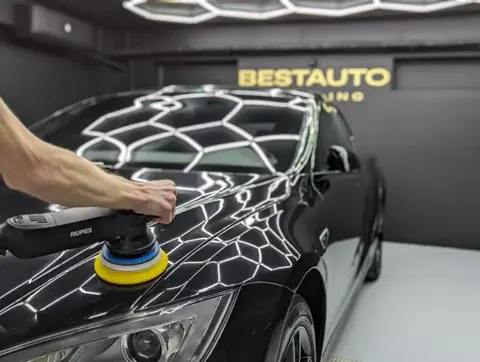
Fix — cerium-oxide polishing:
- Removal depth: 3-7 microns. Glass is optically like new, not physically meaningfully thinner (total windshield thickness is about 5 mm).
- Price: from 250 ₾ for the windshield.
- Time: 1-1.5 hours for all 4 pieces of glass.
- How long it lasts: 2-4 years, given blade replacement every 6-8 months and washer fluid before the wipers.
After polishing the torch check shows a "clean" glass again — oncoming lights are point sources without halos. More on the technology in our article on glass polishing or on the auto glass repair page.
Pit pitting from glass ageing
Pit pitting is hundreds of microscopic craters on the glass, each from a single tiny-stone impact at speed. One crater is invisible; 500+ per square metre makes the glass visually matte.
Tbilisi statistics: a 3-year city car — 100-200 pits, barely visible. A 5-year car — 500-700, visible at night. An 8+ year car or one active on mountain routes — 1000-2000 and the glass looks "matte" in headlights at night.
Pit pitting lives more in the central and upper glass (where stones arrive most). The driver's own zone usually suffers more because the driver grips the wheel firmly and manoeuvres less, taking the impacts head-on.
Fix scales with depth:
- Light pit pitting (0.1-0.2 mm) — polishing at 250 ₾. 3-7 microns off smooths crater edges and removes scattering.
- Medium pit pitting (0.2-0.4 mm) — grinding at 400 ₾. 30-100 microns off meaningfully reduces crater depth and clears the haze.
- Heavy pit pitting (0.5+ mm, dense) — replacement. Grinding that deep risks leaving the glass dangerously thin.
Under-the-lamp inspection assesses density and depth. A hand run across the outer surface gives a rough feel: if it feels like fine sandpaper, you are past polishing — grinding or replacement.
Film from bad washing and de-icer
Surface film is the most frustrating case: fastest to fix, but usually what masquerades as "the glass has aged". Film forms from:
Car-chemistry residue. Cheap washes wipe the glass with the same sponge used on the bodywork — surfactants and waxes transfer across. Waxes do not rinse off with plain water and leave a thin layer that traps dust.
Acid-rain traces. Rare in Tbilisi, but real after dust storms from regional deserts: droplets mix with mineral dust and react mildly acidic on the glass, leaving thin tracks along the drip paths — "tears" visible in side light.
Salt de-icer traces. Winter Tbilisi roads carry a salt-and-sand mix. Spray from other cars lands on the glass; if not rinsed off it crystallises and leaves marks.
Insect protein. Summer months bring bugs. At 80-100 km/h on Tbilisi-Batumi or Tbilisi-Kazbegi, bug bodies bake onto the glass; plain water does not remove them — you need a bug-specific cleaner.
Diagnosing film: after a standard wash the glass is "not quite clear" and a soft veil is visible against the light. Nail test: a fingernail slides across film with slight resistance, and across clean glass like on a mirror.
Fix — deep glass wash with pro chemistry:
- Isopropyl alcohol degrease — removes wax residues.
- Mild-acid cleaner — removes mineral deposits and de-icer traces.
- Bug cleaner — for any protein traces.
- Gentle finishing polish — clears any micro-abrasion from the cleaning.
20-30 minutes and done as part of a full glass polish. If the glass is still unclear afterwards, the issue is not film but micro-scratches or pit pitting — polish or grind.
Factory laminate defects (rare)
Rare but real — a defect inside the glass itself. The laminate is two glass layers with a PVB film between. If manufacturing or a severe overheating event caused delamination, clouding or bubbles in the PVB, it is irreversible.
Visual signs:
- A local "cloud" — cloudiness in one spot, on one side of the glass (look at the edge from the side for visible delamination).
- Internal bubbles — small round inclusions 1-3 mm, not on the surface.
- Semi-transparent strips — often on the edges of old glass where the plastic has aged from UV.
Polishing and grinding do not reach the PVB — they work only on the outer surface. Replacement is the only path.
At inspection we tell inside from outside with the fingernail test: if you feel relief, the defect is external and can be worked; if the surface is smooth and the defect sits "inside", it is laminate, replacement only.
Book an under-the-lamp diagnosis and glass assessment via the windshield repair form — free, 5-10 minutes.
Tbilisi-specific factors that accelerate wear
Tbilisi ages windshields faster than average:
Summer heat and UV. August glass on direct sun reaches +60°C. Tbilisi UV index exceeds many European cities. Result: PVB ageing 20-30% faster, glass edge may haze by 10 years.
Summer bugs. May to October bring heavy insect activity. Lots of drivers run Tbilisi-Batumi or Tbilisi-Kazbegi where the evening 80+ km/h run brings protein deposits. Without proper cleaning, traces persist.
Winter salt. Tbilisi winters use salt-and-sand. Thaws plus overnight freezes leave mineral crusts that deposit a film.
Dust storms from regional deserts. Periodic (1-3 times a year) dust events passing over Tbilisi dump fine-grain dust that the wipers drag across until the next wash.
Mountain roads. Kazbegi, Bakuriani, Gudauri runs — mountain tarmac throws more stones, pit pitting accumulates 2-3 times faster than on city-only cars.
Prevention — same as our article on glass polishing: new blades every 6-8 months, washer fluid before wipers, no metal ice scraper, good washing. With prevention glass "lives" 7-10 years before the first polish; without — 3-5.
Conclusion
Night windshield visibility is not a matter of the driver's age — it is a matter of the glass's optical condition. Four causes produce similar visual effects (halos, haze, glare), fixed by different technologies: micro-scratches — polishing at 250 ₾; pit pitting — polishing or grinding at 400 ₾; film — deep washing; internal defects — replacement.
Under-the-lamp diagnosis at the studio takes 5-10 minutes and is free. It not only names the defect type but also tells you which side of the glass it is on. That is the only way to pick the right technology and avoid spending 400 ₾ on grinding where 50 ₾ of washing would have done it.
Key takeaways:
- Poor night vision is almost always glass wear, not "the driver's age"
- Wiper micro-scratches — the single most common cause, fixed by 250 ₾ polishing
- Pit pitting from stones — light polishes out, heavy needs 400 ₾ grinding
- Surface film — reversible by deep washing, the most underestimated cause
- Internal laminate defects — replacement only; diagnosis is free
FAQ
Why does night visibility get bad through the windshield when daytime looks fine?
It is an optical scattering effect on glass defects. Daylight's diffuse sky light masks halos and haze. At night, point light sources (oncoming headlights) make every defect visible — every micro-scratch and crater works like a tiny prism. Cause is usually cumulative: 3-5 years of driving with irregular blade replacement and improper washing. The under-the-lamp studio inspection shows the exact defect type and its fix.
How much does fixing windshield visibility cost?
Depends on cause. Deep wash (if it is film) — inside a general wash. Windshield polishing (micro-scratches, light pit pitting) — from 250 ₾. Grinding (medium pit pitting, deep scratches) — from 400 ₾. Replacement (internal laminate defects) — substantially more expensive, referred to glass specialists. Full pricing for our procedures is on the auto glass repair page.
Can polishing really restore "factory-like" visibility?
For fresh defects (micro-scratches, film) — yes, the glass after polishing is visually indistinguishable from new. For deep defects (0.3+ mm pit pitting, internal defects) — no, even grinding only partly restores. Honest framing: polishing gets 90% of cases back to "almost new", and improves but does not fully fix the other 10%. At inspection we are candid about what your specific case will deliver.
How often should a windshield be polished to keep visibility intact?
With prevention (quality blades, washer fluid before wipers, correct washing, hydrophobic coating) — every 4-5 years. Without prevention — every 2-3 years because glass wears faster. More frequent polishing is not recommended — in the driver's zone, many repeat procedures cumulatively remove enough material to introduce optical distortion.
Can new wipers help without polishing?
New blades will stop producing new micro-scratches but will not remove existing ones. If the glass already has a 3-5-year "fan" from old blades, new blades just freeze the state at the current level — they do not restore clarity. Restoration needs polishing; after polishing, new blades hold the result for 2-4 years.
Book a glass diagnosis and auto glass repair at BESTAUTO via the form on the service page or by phone to whichever studio is more convenient in Tbilisi, Georgia:
- BESTAUTO Guramishvili — Guramishvili Ave. 78, tel. +995 550 000 299
- BESTAUTO Politkovskaya — Anna Politkovskaya St. 51, tel. +995 550 000 199
Both studios are open Monday to Saturday, 10:00–20:00. The under-the-directional-lamp inspection is free — in 5-10 minutes we identify the cause of the visibility loss and tell you which technology (polishing 250 ₾, grinding 400 ₾, replacement) applies to your case.