Wash frequency is not a matter of taste but a matter of what the environment is doing to your clearcoat right now. In Tbilisi the seasons affect the body very differently: in summer the main problem is dust and insects stuck to the bumper; in winter — salt and slush from mountain roads; in autumn — leaves and rain streaks; in spring — poplar fluff and pollen. A universal "wash once a week" does not work for this city — part of the year it is too often, part of the year too rare. Below is a concrete wash schedule by season, with numbers and reasons, and what changes for cars with ceramic coating or PPF.
Summer (June-August) — twice a week
The summer problem in Tbilisi is dust and insects. Dust settles on the clearcoat constantly, and within 3-4 days the hood shows a matte film that plain water from a hose will not remove. On top of that come insect remains: butterflies, flies and mosquitoes stuck to the grille and the hood leading edge. Within a day under Tbilisi sun, chitinous particles dry up and start etching into the clearcoat chemically.
Optimal frequency — twice a week, especially if the car is parked outdoors and driven daily in the city. Minimum — once a week; less often and insects have time to lock in, then come off only with separate chemistry at risk of streaking.
What matters in summer:
- Wash only inside a shaded bay, never under direct sun — shampoo dries on the body within a minute
- Water temperature cool, not cold — a sharp drop on hot clearcoat creates microcracks
- After long trips (Borjomi, Kakheti, Kazbegi) — mandatory wash the same day, not tomorrow
In practice, a 2-phase sedan wash at 40 ₾ every 3-4 days is a reasonable summer budget. If the car sleeps in a garage and is driven on weekdays only — the interval can stretch to 5-6 days.
Autumn (September-November) — once a week
In autumn dust decreases but a new problem appears — rain streaks and fallen leaves. Tbilisi rain is rarely clean: it carries dust, exhaust soot, mountain clay. After drying, the body shows brownish streaks, particularly visible on dark cars. Wet leaves stuck to the hood or windshield leave organic stains under sun that etch into the clearcoat within 12-24 hours.
Frequency — once a week for most cars. If you got caught in a heavy rain with hail or drove through leaf-fall in a park zone — a wash within 1-2 days.
In autumn a full 3-phase cycle matters less — a 2-phase is often enough: pre-wash foam plus hand wash with the two-bucket method. The third-phase hydrophobic layer holds poorly in wet weather due to constant soaking.
Winter (December-February) — 3-4 times a month
Winter in Tbilisi is the hardest season for the body. Snow in the city is rare, but on mountain exits (Gudauri, Bakuriani, even the climb to Kojori) road salt is used actively. Salt solution on the clearcoat causes corrosion fast — particularly in chip spots, under arches, at the lower edge of doors and on sills. On mountain-going cars with heavy winter use, arch corrosion starts within 2-3 years if the body is not washed regularly.
Frequency — 3-4 times a month, meaning roughly once a week. On days after a mountain trip — wash within 24 hours, no later. After salt spreading on the Cross Pass, skipping the wash is unacceptable — every day acts as a corrosion accelerator.
What matters in winter:
- Mandatory wash of the underbody and arches (not all regular washes do this — ask beforehand)
- Water temperature neither cold nor hot — the gap between outdoor frost and warm water stresses the clearcoat
- After the wash — mandatory drying inside a bay, otherwise water in door and trunk locks freezes
In winter a 3-phase wash with hydrophobic layer works better — the protective film repels salt solution and makes the next wash easier. SUV 3-phase — 59 ₾, justified in winter.
Spring (March-May) — once a week with pollen adjustment
Spring in Tbilisi brings two specific problems: poplar fluff and pollen. Fluff in late May-early June sticks to everything — grille, wipers, vents — but is relatively safe for the body. Pollen is another matter: fine yellow-green particles settle on the clearcoat and, under morning dew, form a film that works like a thin abrasive when dried. Within 2-3 days without a wash, white and silver cars show a yellow coating.
Frequency — once a week in normal weeks, twice during active pollen periods (late April-early May). Washing quickly after spring rain matters especially: pollen mixed with rain forms a sticky film.
Spring also starts the long-trip season: May holidays, first barbecues in Kakheti. After each such trip — a wash on return, do not postpone.
Cars with PPF or ceramic — plus one level to the schedule
For cars with protective coatings the baseline schedule changes in one direction: same frequency, but chemistry must be pH-neutral. Meaning twice a week in summer, once a week in winter — no less often. Going rarer is not possible because:
- On PPF stuck insects and pollen start yellowing the film itself within 5-7 days
- On ceramic, any dirt pressed in by rain forms water streaks in a week that only come off with a new layer
- Salt on a ceramic with a missed wash locks into the top layer of the coating and comes off only with polishing
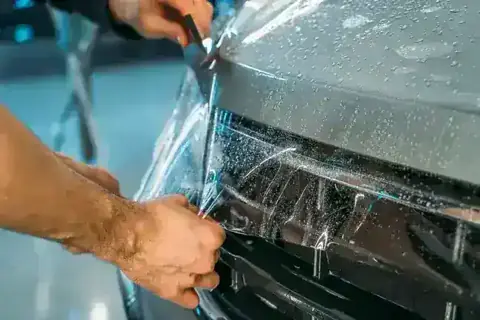
If the main reason you installed ceramic or PPF was "to wash less" — that is unfortunately a myth. Protective coatings extend clearcoat life and simplify the wash itself (dirt releases easier), but do not cut the number of washes. Polishing every 2-3 years restores the gloss but does not protect against new chips — if long-term protection matters, a more reliable solution is PPF paint protection film, which takes the hit on itself.
A chemistry note: at washes that clean ceramic- and PPF-coated cars with the same alkaline shampoo as everything else, the coating degrades in 3-4 cycles. If you ask about detailing, also ask about a separate pH-neutral shampoo for your coating type.
After long trips — a separate wash regardless of season
A long trip in Tbilisi almost always means contact with something city streets do not have: mountain dust (Kazbegi, Svaneti), roadside clay (Kakheti after rain), sea salt spray (Batumi in August), conifer resin (Borjomi, Bakuriani). All these demand a wash within 24-48 hours, otherwise they start working against the clearcoat.
Pine and spruce resin is a separate topic. On the hood and roof it hardens under the sun and comes off only with a specialist solvent (a standard shampoo will not touch it) or a clay bar. If resin has stood for more than a week, a small polish is likely needed.
Batumi sea salt is finer than winter road salt but works the same way: penetrates clearcoat microcracks and starts corrosion. After Adjara a wash is mandatory, preferably with underbody focus.
Quick reference: schedule by season
| Season | Frequency | Priority |
|---|
| Summer (June-August) | 2 times/week | Dust, insects |
| Autumn (September-November) | 1 time/week | Rain streaks, leaves |
| Winter (December-February) | 3-4 times/month | Salt, arches, underbody |
| Spring (March-May) | 1-2 times/week | Pollen, poplar fluff |
Plus a separate wash after every long trip and right after heavy rain (autumn) or a mountain drive (winter). Current pricing across all phases — on the detailing car wash in Tbilisi page.
FAQ
Is washing once every two weeks enough year-round?
No. In summer and winter in Tbilisi a two-week interval causes accelerated clearcoat wear. In summer insects and dust lock in within 5-7 days; in winter salt from mountain roads starts working immediately. Twice a month is the minimum for autumn-spring, and not always even then.
Can I use an automated wash tunnel with ceramic?
Technically yes, but the coating degrades fast. Brushes leave micro-scratches on ceramic; alkaline chemistry strips the hydrophobic layer in 3-4 cycles. If you paid 500 ₾ for ceramic, it is more logical to pay extra for a detailing wash and preserve the coating than to save on each wash and redo the ceramic coating within a year.
Is a winter wash needed if there is no snow?
Yes, and more actively than usual. Snow in Tbilisi is rare, but salt on mountain exits is used heavily. Even if you do not go to Gudauri, the Mtskheta highway and climbs toward Kojori are salted. Salt settles on arches and underbody and starts corrosion over winter.
How much is a 3-phase SUV wash in winter?
A 3-phase SUV wash at BESTAUTO is 59 ₾ (plus engine bay wash 80 ₾ separately, if needed). The third phase is a protective nano-shampoo or wax booster that creates a temporary hydrophobic layer for 3-4 weeks. It works better in winter than in summer because it makes removing salt easier on the next wash.
How often to wash after long trips in summer?
Immediately on return, ideally the same day. Mountain dust, tree resin and stuck insects start chemically attacking the clearcoat overnight under the sun. If the trip was over 300 km on the highway — a wash is mandatory; if shorter — judge visually: if the bumper and hood are covered in insect spots, a wash is needed.
Conclusion
There is no universal wash schedule for Tbilisi, Georgia — frequency adapts to the season. Summer twice a week for dust and insects; autumn once a week for rain streaks and leaves; winter 3-4 times a month to fight mountain-road salt; spring once or twice a week with a pollen adjustment. Plus extra washes after long trips and bad weather.
For ceramic- or PPF-coated cars the schedule stays the same but with a mandatory pH-neutral chemistry requirement — otherwise the coating fails within a few cycles. Skipping washes does not save money, it accumulates damage that later becomes an abrasive polish starting at 690 ₾ or PPF reinstallation.
Key takeaways:
- Summer — 2 times/week, winter — 3-4 times/month, autumn/spring — 1-2 times/week
- After a long trip or heavy rain — a separate wash within 24-48 hours
- On ceramic/PPF cars the frequency stays; only pH-neutral shampoo is acceptable
- In winter, arch and underbody wash is mandatory, ideally with the 3-phase hydrophobic layer
- Skipped washes in summer = etched-in insects; in winter = arch corrosion
Book a detailing wash at BESTAUTO via the form on the service page, or call whichever studio is closer in Tbilisi, Georgia:
- BESTAUTO Guramishvili — Guramishvili Ave. 78, tel. +995 550 000 299
- BESTAUTO Politkovskaya — Anna Politkovskaya St. 51, tel. +995 550 000 199
Both studios are open Monday to Saturday, 10:00–20:00. When booking, mention when your last wash was — it helps pick the right phase.