Full body PPF wrapping is something premium-car owners in Tbilisi, Georgia commission once every 7-10 years. It is not a quick job: the car stays at the studio for 5-7 days, the body keeps curing for another week or two during normal use after install, and the end result is paint sitting under a 150-200 micron polyurethane "suit" that will absorb a decade of stone chips, wash marks and sun damage. Below: what full PPF wrapping actually is, how the technology breaks down, how it differs from front-group-only protection, and when this investment pays off versus when it makes more sense to stop at hood and bumper.
Full wrap vs front-group protection
The front group is hood, front bumper, front fenders, A-pillars, sometimes headlights. Roughly 30-40% of body surface and the highest-risk zone: 90% of road-stone chips land on this part. A full wrap covers the whole car — doors, rear quarters, rear bumper, roof, pillars, sometimes mirrors and rocker panels. The covered area is 2.5-3 times larger.
Partial protection is straightforward in logic: spend money where the impact actually happens. The hood catches stones, the front bumper takes gravel from the side, the headlights crack from UV and point hits. The rear bumper sees occasional parking damage; doors barely suffer in motion; the roof picks up branch scratches and bird droppings.
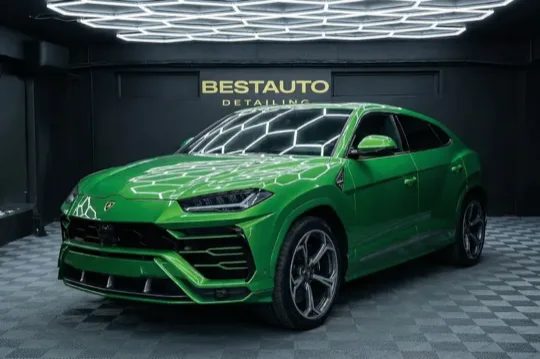
Full wrap makes sense in three scenarios. First — a premium car at 0-2 years of age where the owner wants to preserve factory paint for a decade. Second — a vehicle planned to be kept 5+ years and held long-term as an asset (collector cars). Third — a freshly repainted body after major bodywork, where the new paint needs full coverage protection.
For most city cars in Tbilisi the optimal strategy is front group plus selective coverage of mirrors and pillars. That closes 80% of real risks for 30-40% of the full-wrap budget.
Full wrap technology: 5-7 days, broken down by stage
A full PPF wrap is not "stick on the film" — it is a long chain where every stage matters.
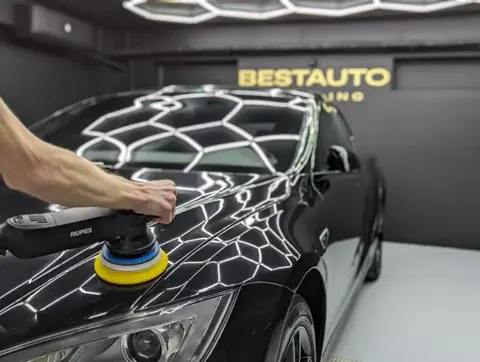
Day 1: intake and paint prep. Two-phase wash with a degreaser to remove dust and salt residue. Clay bar across the whole body to lift embedded tar and metallic brake dust. Then paint diagnosis under inspection light: clearcoat thickness measured per panel, scratches and chips identified for correction before film. If holograms or wear are present, light finishing-pad polishing is scheduled. PPF goes onto perfectly flat paint — any defect underneath gets locked in for the lifetime of the film.
Day 2-3: cutting templates. Modern studios use a plotter with digital templates per car model (sometimes per year and trim, because the same body has different door handles depending on the package). Templates cut out large panels seamlessly: hood whole, fender whole, door whole. On complex parts — rear bumper with a diffuser, front bumper with intakes — a minimal seam in a hidden zone is acceptable.
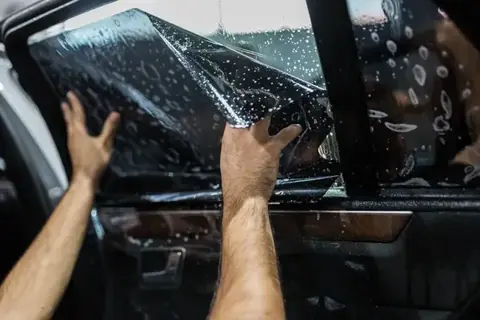
Day 3-5: installation. Each panel is removed or masked, the surface is generously wetted with soapy solution, the film is pulled with a squeegee, water and bubbles are pushed out. Complex contours (mirrors, handles, bumper with grille) are installed manually with adhesive thermo-activation by heat gun — the film softens under heat and conforms to the shape without wrinkles. This is the most labour-intensive part: a large crossover takes 60-80 person-hours.
Day 5-6: UV cure and check. After install the adhesive is activated by UV lamp or heat — this stage compresses curing from 7-14 days down to 24-48 hours. Then control under directional light: looking for spots of poor adhesion, small bubbles, uneven seams. Defects are reinstalled.
Day 7: handover and instructions. Car returns to the client with a brief: no washing for the first 7-10 days, no parking under direct sun for more than 4-6 hours in a row, avoid airport long-stay facilities with brush automatics. After two weeks the film is fully set; after that — normal use.
What you get: list of changes
After a full PPF wrap the car looks almost identical to before — that is the goal. But operationally a lot changes:
Chip protection. Road stones, gravel, branches, keys in the pocket of someone passing by, a part dropped on the hood in the garage — the film absorbs all of it. Paint underneath looks new for a decade.
Self-healing of surface scratches. Fine wash marks, branch traces, card or keyfob scratches — disappear under warm water or sunlight in 5-30 seconds. Deep scratches do not heal, but 80% of fine ones do.
Chemical and de-icer protection. Tbilisi winter de-icers eat through unprotected clearcoat in 2-3 seasons, especially on lower door edges and rocker panels. PPF blocks direct contact — chemistry stays on the film and washes off.
UV fade protection. Premium PPF (Llumar, LuxArmor, Quantum) carries UV stabiliser that slows fading on bright paint (red and blue particularly).
Resale value retention. At resale 3-7 years later, a fully wrapped car commands a noticeable premium from private buyers and dealers — preserved paint is visible on inspection. This usually offsets a meaningful share of the original film cost.
What full wrap does not do: protect against impacts that deform metal, prevent vandalism with sharp tools, restore already-damaged paint underneath (so polish is mandatory before install).
Pricing and what drives it
Full PPF wrap pricing is shaped by several factors: vehicle size, chosen film brand, body complexity (number of small parts, bumper shape, presence of diffusers), and need for prior polishing.
At BESTAUTO the front group (hood, bumper, fenders, A-pillars) starts at 2500 ₾. Full body wrap is calculated at in-person inspection based on size and number of elements. Per-position add-ons from the price list: front headlights from 350 ₾, panoramic roof from 900 ₾, windshield protection film from 1100 ₾, interior trim protection film from 800 ₾, fender protection film from 600 ₾.
The full per-position PPF price list lives on the paint protection film service page. The final figure for a full wrap on a specific car is set at in-person inspection after measurements and an assessment of body complexity.
Worth understanding: between premium films Llumar, LuxArmor and Quantum the price gap is 10-25%, while real-world performance is essentially equivalent. All three carry 10-year manufacturer warranty, are transparent, and offer self-healing. Selection is usually driven by stock availability and compatibility with the car's colour.
When a full wrap makes sense, and when it doesn't
Simple test: estimate how long you plan to keep this car and what its market value will be in five years.
Worth doing if: car is new or 0-2 years old, value is 50000+ ₾, you plan to own 5+ years, daily Tbilisi driving with active urban traffic, on-street parking. Also worth it for classic and collector cars, where the film is not about economics but about preserving original paint as a cultural artefact.
Not worth doing if: car is 5-7+ years old with worn paint (polish first, then decide), budget-segment vehicle where the film would be a significant share of the car's value, planned sale within a year or two, garage-kept and minimally used.
Middle ground: 2-4 year-old car in mid-segment — usually the right call is front group plus selective coverage (mirrors, A-pillars, handles). 80% protection on 80% of real threats for one-third of full-wrap cost.
FAQ
How long does a full PPF wrap take?
On average 5-7 working days under standard studio load. A large crossover or complex bodywork — up to 10 days. The timeline includes all stages: prep, cutting, install, UV cure, check. After handover, another 7-10 days of careful use is recommended for full adhesive set.
Can a full wrap be done in stages — front first, then the rest?
Technically yes, and many do. Front group first (hood, bumper, fenders, A-pillars) — that is the most important protection. A year or two later, when the real effect is visible, doors, rear quarters, bumper and roof are added. Downside: staged install does not always allow matching one batch of film, so micro-shade differences between panels can appear (invisible on clear film, critical on matte).
How does full PPF wrap affect resale?
At resale 3-7 years on, a fully wrapped car typically sells at a noticeable premium over an equivalent without film — private buyers see preserved paint, dealers raise the trade-in number. That covers a meaningful share of the original film cost. With paperwork from a verified studio and remaining 3-5 years of manufacturer warranty, the premium goes higher.
What happens to PPF after 10 years?
Premium films (Llumar, LuxArmor, Quantum) carry 10-year warranty. In real Tbilisi use the film holds 8-12 years without visible problems. Beyond that age signs appear: light yellowing of clear film on the hood, gradual loss of hydrophobic behaviour, localised clouding where heavy impact landed. Removing old film and installing new is a standard procedure — adds 1-2 days to a normal install.
Can a fully wrapped car be washed normally?
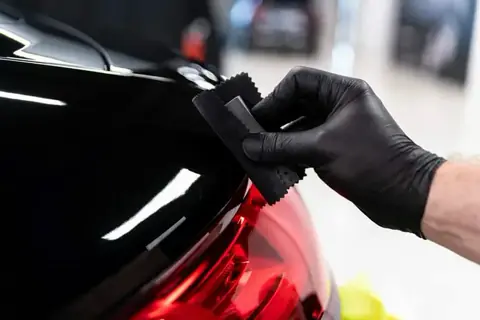
Yes, after the first 7-10 days. Optimal: two-phase or three-phase wash with pH-neutral chemistry, hand drying with microfibre. Touchless wash is fine. Avoid: brush automatic washes (micro-scratches over the film), aggressive alkaline engine-bay chemistry near hood edges, high-pressure wash too close to film edges (lift risk on cuts).
Conclusion
A full body PPF wrap is a serious investment: 5-7 days in the studio, real budget, a week or two of careful use after install. In return the car gets a decade of protection from chips, wash scratches, chemistry and UV fade, plus a resale premium. For a new premium car you intend to keep long-term, this is almost always justified.
For most city cars in Tbilisi, however, the optimal strategy is not full wrap but front-group protection plus selective coverage of mirrors and pillars. That covers the actual risk points for one-third of the budget. The decision for a specific vehicle is made at in-person inspection based on age, paint condition, budget, and the next 5 years of intended use.
Key takeaways:
- Full body PPF wrap takes 5-7 days at the studio plus a week or two of adhesive cure
- Most cars are well served by the front group (hood, bumper, fenders, A-pillars) — from 2500 ₾
- Full wrap is justified on new premium cars, 5+ year ownership, or post-bodywork
- Premium films (Llumar, LuxArmor, Quantum) hold 8-12 years with 10-year manufacturer warranty
- Self-healing closes up to 80% of surface scratches; deep impact and clearcoat chips do not appear at all
Book paint protection film at BESTAUTO via the form on the service page, or call whichever studio is more convenient in Tbilisi, Georgia:
- BESTAUTO Guramishvili — Guramishvili Ave. 78, tel. +995 550 000 299
- BESTAUTO Politkovskaya — Anna Politkovskaya St. 51, tel. +995 550 000 199
Both studios are open Monday to Saturday, 10:00–20:00. A free in-person inspection comes first — the technician measures the car, evaluates paint condition, walks through options from front group to full wrap, and matches the film to budget and use case.