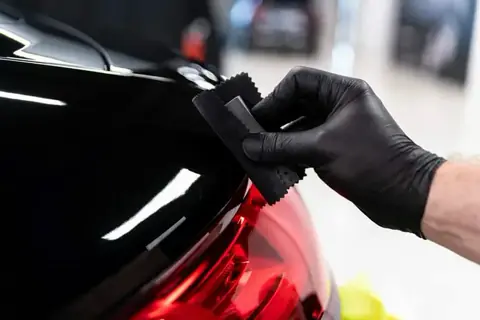
When someone thinks about polishing for the first time, they often imagine a car going into the studio looking slightly tired and coming out “like new.” That feeling is partly true, but the actual effect of professional polishing is more specific. The procedure does not repaint the vehicle, does not create a new layer of lacquer, and does not erase serious physical damage where the coating is already deeply compromised. Its job is to correct the surface — to reduce the flaws that distort reflections, flatten color depth, and give the impression of a dull, hazy, or roughly washed car.
After polishing, four things usually change the most. First, the gloss becomes cleaner: the surface stops looking tired and starts reflecting light more evenly. Second, the visibility of micro-scratches is reduced, especially on dark colors where circular wash marks stand out the most. Third, the perception of color changes: black looks deeper, white looks cleaner, red becomes richer, blue looks more saturated. Fourth, the overall impression changes: the car looks more expensive, more orderly, and much better cared for, even if the viewer cannot immediately explain why.
At the same time, expectations must remain realistic. Not every defect disappears. Deep scratches, serious lacquer damage, stone chips, poor repainting, and very thin paint do not always allow for aggressive correction. That is why a good polishing result is not about grinding the finish to perfection at any cost, but about achieving the right safe balance between visual improvement and paint preservation.