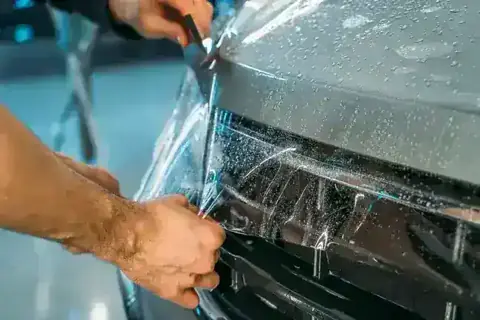
The windshield is the prime subject of an inspector's attention at technical inspection. Through it the driver looks, through it others look at the driver, and the safety of everyone around depends on windshield transparency. Georgian legislation in 2026 requires at least 70% VLT on the windshield — the film must pass at least 70% of visible light. That cut-off removes every dark option and leaves only four legal choices: a sun strip at the top, a clear athermal film, an anti-glare film, or no film at all. Below: what of this actually works in Tbilisi, Georgia, how the inspector checks each variant, and what to do when you want heat protection without breaking the law.
In Georgia, windshield tint rules sit inside the general regulation on automotive window tinting. Key 2026 points:
At inspection the inspector measures with a tint meter from inside and outside: the passenger window is lowered, the device clips to the windshield in the rear-view mirror area. A reading below 70% — act, fine, removal order.
The most common legal option in Tbilisi. The strip is a dark film 10-14 cm wide, applied to the top edge of the windshield, above the factory-printed sunshade area. Its job is cutting direct sun from the driver's eyes at sunrise or sunset when the visor is not enough.
Why the strip is legal: it sits above the normal driver field of view. In proper seating (rear-view mirror at eye level), the line of sight passes below the strip. The inspector measures the centre of the glass with the meter, not its top edge, so the strip stays outside the reading.
Strip variants:
In Tbilisi, the strip especially pays off for drivers who often run highways at sunrise or sunset (toward Kazbegi, Kakheti, the Black Sea coast). Under low sun, the strip reduces eye fatigue and keeps reaction time on the road.
Base pricing for a strip install on a windshield at BESTAUTO starts at 290 ₾. Final figure is set at inspection depending on film type. Details on the window tinting service page.
An athermal film with VLT 85-90% visually barely tints the glass, but blocks 90-98% of infrared radiation — the main source of solar heat. On the windshield the effect is felt from the first minute of parking in the sun: cabin temperature 5-8°C lower, plastic dashboard does not scorch, steering wheel stays warm but not burning.
How to tell legal athermal from illegal dark film: athermal is nearly clear, with a faint blue or green cast in sunlight (from ceramic or metallised layers). Paper VLT — 80% and up. Tint meter reading after install — 72-78%, inside the legal norm.
Athermal on the windshield makes sense paired with athermal on the front sides — full front-group heat protection. On rear windows you can go with dark athermal (VLT 20-35%) — no limits there, and the dark cast adds privacy.
What is inside athermal:
For a windshield with embedded heating, a Lane-assist camera or a rain sensor, ceramic athermal is the right choice — metallised can shield electronics signals. BESTAUTO works with LLumar (IR series) and LuxArmor — two premium brands with full compatibility.
Anti-glare is a specialty film that scatters oncoming headlights and reduces the night dazzle effect. Particularly useful for light-sensitive drivers and on poorly lit sections with oncoming truck traffic.
The physics: inside the film is a microstructured optical layer that refracts the light of oncoming headlights, reducing its point intensity. Instead of a blinding white patch from the headlights — diffuse light that the eye processes less aggressively. Road visibility does not suffer — total transmission is 75-85%, within the law.
Anti-glare feels different from regular tint: the inside of the film is matte, textured like frosted glass. Not a bubble, not a defect — it is the working optical layer. Outside — glossy like ordinary glass.
Suited to:
Anti-glare can combine with the sun strip and clear athermal — all three work in different ranges.
On the windshield in Georgia, the following are strictly forbidden:
Dark films in a full sheet (VLT under 70%). The inspector issues a fine at the first reading. Even "35% rated" with paper 35% — that is VLT 30-32% after install, three times darker than the norm.
Mirrored reflective films. Even with VLT above 70%, the reflection dazzles oncoming drivers — a separate violation about blinding. As of 2026 mirror films are fully illegal.
"Chromed" or coloured gradients over the whole glass. Blue, green, bronze film covering the entire windshield — a colour violation even if VLT is acceptable. Only a mild technical cast from athermal is allowed.
Self-adhesive decorative elements at eye level. Signs, stickers, curtains covering more than 15% of the viewing area — formally a violation of unrestricted visibility rules.
Opaque "applications" from inside (e.g. matte-effect film). Common among drivers trying to hide a chip or crack — but it degrades visibility and leads to inspection rejection.
If a non-compliant film has been installed, it must be removed within 30 days per the inspector's order. Studio removal is a separate service, final figure set at inspection. Adhesive residue comes off with petrol or dedicated solvents; the glass then needs polishing to remove glue traces — windshield polishing from 250 ₾.
Not every driver wants to deal with windshield film even legally. Three alternatives:
Sun visor extender — a plastic or fabric add-on that clips to the factory visor and extends it downward. No installation, removed after use. Downside: only works at the moment direct sun hits the eyes, does not reduce cabin temperature.
External sun screen — a silver reflective fabric placed on the inside of the windshield during parking. Works only while parked; must be removed before driving. Effective against uncontrolled cabin heating: drops temperature after an hour in the sun by 10-15°C versus bare glass.
Athermal windshield (AS-2 glass). Some manufacturers fit a special glass with a built-in athermal interlayer between the triplex layers. Factory athermal blocks 50-70% of IR with no film at all. Check whether your car has AS-2 — look at the marking in the lower corner of the windshield: "Solar" or "Coolwave" indicates athermal glass.
If the car has factory athermal glass and you want more protection, you can add an athermal film on top. Combined effect — over 95% IR blocking, comparable to a climate-controlled car while parked.
Yes, but only with a film at VLT 70% or higher — meaning nearly clear. Most commonly installed: an athermal film at 85-90% VLT (visually unnoticeable, blocks heat) plus a sun strip up to 14 cm wide at the top. Dark film on the windshield is forbidden and will fail inspection.
Up to 14 cm from the top edge of the glass. That zone sits above the driver's sight line in proper seating and formally outside the field of view. VLT rules do not apply there — the strip can be any darkness or colour, including gradient or decorative text.
VLT (Visible Light Transmission) is the percentage of visible light passing through the glass with film. The inspector uses a tint meter: clips the device inside and outside the glass, and the device shows a figure. Legal requirement: 70% and above on the windshield and front sides. Rear windows are not measured — no limit there.
Base price at BESTAUTO is from 290 ₾ for a windshield. The exact figure depends on film type (ceramic athermal is 30-50% more than plain clear) and glass size. Final figure at inspection. Full pricing on the window tinting service page.
Tint is not installed over cracked glass — film will not level a crack and will not stop its spread. First, chip or crack repair with resin (from 60 ₾ per chip), then glass polishing (from 250 ₾), and only then film installation. If the crack is too large — the glass is replaced.
Legal windshield tinting in Georgia exists but runs in a narrow band: a sun strip on top, clear athermal across the full sheet, an anti-glare layer. Anything dark, mirrored or coloured is outside the law and will cost you at inspection.
For Tbilisi, the optimal setup: ceramic athermal film 85-90% on the windshield and front sides (blocks heat, visually invisible) plus a sun strip 10-12 cm at the top (comfort under low sun). The combination is legal, drops cabin temperature by 5-8°C, and eases the eyes under any lighting.
Key takeaways:
Book windshield tinting at BESTAUTO via the form on the service page, or call whichever studio is more convenient in Tbilisi, Georgia:
Both studios are open Monday to Saturday, 10:00–20:00. Before installation — a free tint-meter reading before and after, a consultation on choosing a legal film, and selection of a sun strip specific to your car model.
Our detailing studio will handle your task with quality
Book a consultationBook a visit
Write your phone number, we will call you back and tell you everything about the service you are interested in
Free inspection, pre-consultation and booking for main services available at both locations